Proposed Project Governance Model
Project Governance
Project governance refers to the set of guidelines, roles and responsibilities that define the authority structure and the decision process in a project.
Governance Model
Traditionally the governance of the projects conducted by Canadian Banks are regulated by a steering committee form with executives of different areas, while the rest of the team including the project management team follow the guidelines documented in the responsibility assignment matrix or RACI.
The following governance model is a multi-tiered structure that distributes the decision authority across segments of management. This approach aims to create a dynamic alternative to the traditional steering committee by foster the engagement, participation and ownership among members of the project team.
Tier 1 Operational
The Operational Team is lead by the Project Manager with the support of Team Leaders; this group have the authority to make decisions that impact the day to day execution of the project.
This involves aspects such as: schedule changes at work package level, frequency of project meetings, project team communication, the identification of solutions which satisfy requirements, issues, risk and minor cost changes as per approved limit.
The Operational Team will support their decisions based on factual information recorded in the project status report and project tracking log. The status report must contains operative information like the the progress of project tasks, risk and issues impacting key performance indicators KPI (Scope, Cost, Schedule, Business Case, Resources among others). This status report will be shared with the next two tiers.
The suggested cadence for the Operational Team to meet is weekly.
The decisions and changes made by the Operational Team must not impact key aspects of the project such as the launch or release date, selection of solutions to be implemented, overall business and IT costs. In addition, items that cannot be resolved without the decision from a direct manager of any of the members of the Operational Team will be escalated to the next tier in the governance model.
Tier 2 Tactical
The Tactical Group is led by the Project or Program Manager with the support of the Product Owner, Senior Managers, Directors or Assistant Vice-president AVP members.
This group has the authority to make decisions which help achieve specific objectives of the business strategy as defined in the project or program scope. This involves aspects such as launch or release schedule changes, selection of solutions to be implemented to satisfy requirements, resolution of issues and risks impacting business value and cost changes of the overall project(s).
The Tactical Group will support their decisions based on the information recorded in the project status report and project tracking log that impact the following KPIs: IT and Business Cost, Key Milestones, Business Case; Interdependencies. This information is an input for the next tier report.
The suggested cadence for the Tactical Group to meet is biweekly.
The decisions and changes made by the Tactical Group must not impact key aspect such as business case strategy alignment (project(s) mission) and source of overall funding; Items that cannot be resolved without the decision from a direct manager of any of the members of the Tactical Team will be escalated to the next tier in the governance model.
Tier 3 Strategic
The Strategic Board is chaired by the Project Management Offices Manager, Program Manager or Project Manager but led by the Project Sponsor.
The Strategic Board is formed by executives (Vice-president, Senior Vice-president, CEO level). This group has the authority to make decisions that change the mission and vision of the business strategy, the strategic alignment of the program or project(s) and the overall source of funding. In addition, the Strategic Board helps the Tactical Group to remove road blocks and also offers advice of the organizational political impact of their decisions.
The Strategic Board will support their decisions based on the information recorded in a specific report targeted for this audience. This report contains overall financial information, issues and risks impacting business value and strategy, and a clear description of the decisions or actions required by this group.
The suggested cadence for the Strategic Board to meet is monthly
Looking for free PDUs?
These sites are offering PDUs for free, please note that I don’t have any association with these providers and the sole purpose of this post is to share this information with fellow project managers practitioners; if you have similar information don’t be shy and share.
6sigmastudy is offering 8 PDUs if you enroll in the Six Sigma Yellow Belt course.
http://www.6sigmastudy.com/online-courses.asp
Scrumstudy
10 PDUs by taken the Scrum Fundamental Certified course
Project Management Maturity Landscape
Back in 2007 and 2008, I had the great opportunity to evaluate the organizational project management maturity of today’s most recognized brand in the retail banking industry in Canada according to Interband.
It was the time when the top five banks expanded or consolidated their operations overseas in an effort to find new sources of revenue and to increase their presence in the global financial market. TD purchased the New Jersey based Commerce Bancorp; RBC completed the acquisition of RBTT Financial Group in Trinidad and Tobago and four wealth and investment firms in US; Scotiabank purchased several banks and related financial services across Latin America (Grupo Altas Cumbres, Banco del Trabajo, Banco de Antigua and ProFuturo AFP), and BMO bought Griffin, Kubik, Stephans, and Thompson based in Chicago.
The expansion seemed to be an indication that Canadian banks were prepared to take a risk and penetrate markets dominated by global giants as JPMorgan Chase Bank, Bank of America, Banco Santander, Wells Fargo Bank and Citibank.
However, does this mean they also achieved the project management maturity to manage the risks, challenges and opportunities of those markets?
Method and Results.
For the evaluation, I had selected the Organizational Project Management Maturity Model (OPM3) standard as this method offers the ability to measure the overall bank project management maturity against a comprehensive and broad-base set of organizational project management best practices. In comparison to the Capability Maturity Model Integration (CMMI) from the Software Engineer Institute that focuses on the evaluation of the processes for developing and maintaining products, services, software and systems.
Results indicated a solid mature set of capabilities in the project domain or the equivalent of CMMI level three for those not familiar with the OPM3 method, and a minimal existence of program or portfolio capabilities. Furthermore, when comparing the results of the assessment against others banks, similar tendencies were identified.
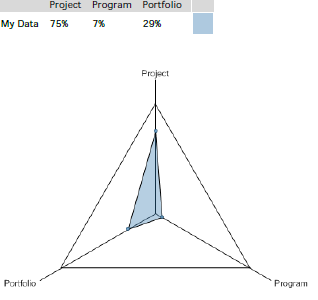
It is important to mention that RBC demonstrated having a solid enterprise program framework and tools, and BMO revealed the most robust and complete set of IT project management capabilities thanks to the adoption and implementation of CMMI back in 2000 and posterior achievement of CMMI level 4 in 2005.
Considering that these banks have a project portfolio configuration of around 90% to 93% stand-alone projects, the near absence of program management indicators maybe justifiable and may not represent a mayor risk to the integrity of the overall investment, because this is compensated by strong financial and risk management practices inherited from other financial operations within the organization.
Portfolio management as defined by the Project Management Institute in the Standard for Portfolio Management, is “the coordinated management of one or more portfolio to achieve organizational strategies and objectives, It included interrelated organizational processes by which an organization evaluates, selects, prioritizes, and allocates its limited internal resources to best accomplish organizational strategies”.
The UK Office of Government Commerce in their Management of Portfolios defined Portfolio Management as “a coordinated collection of strategic process and decision that enable the most effective balance of organizational change and business as usual. Ensuring that prioritized in line with strategic objectives and business priorities and in the context of the existing portfolio, affordability, risk, resource capacity and the ability to absorbed the change”
Base on the previous arguments, the absence of portfolio management capabilities does represent a major risk to the achievement of the Canadian bank’s strategy as fundamental questions, such as; do we have the resource capacity to execute the project portfolio in the timeframe needed to achieve the return of investment? Are we selecting the correct projects? And How we know the right prioritization is in place?, cannot be answered factually.
Future State
In this regard, the necessity to have accurate and better quantifiable objectives in order to maintain competiveness and reduce operational cost overall, will lead the top five banks to adopt and implement program and portfolio management capabilities as part of their enterprise project management framework.
Today there are strong signals that these changes are taking place. As example TD is implementing an Enterprise Portfolio Governance, RBC has Enterprise Project Portfolio Management roles, CIBC deployed an Enterprise Project and Portfolio Management tool and BMO has a Program and Project Management Centre of Excellence. This is excellent news as it demonstrates that Canadian banks are on the right track to deal with the challenges and opportunities that the international markets have to offer.
Views on Project Management Maturity
A mature project management organization represents a better internal and external customer experience, a reduction of project cost execution and the opportunity to stay competitive.
 Jimmy Pimentel